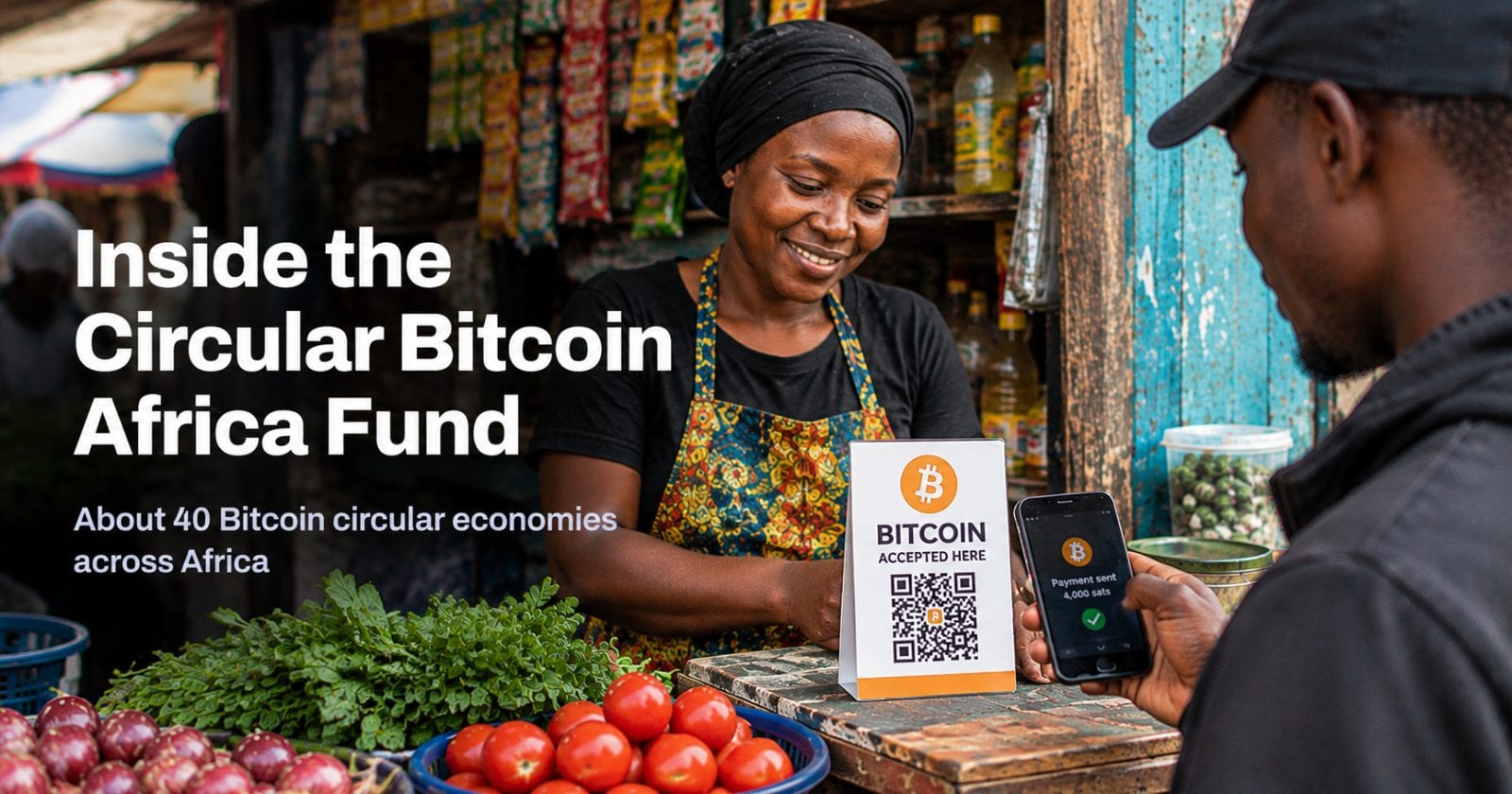
Damiano Magak collects garbage and sells food in Kibera, Nairobi. "I prefer Bitcoin to M‑PESA because M‑PESA transaction costs are higher and the network can be slower," he says on the Circular Bitcoin Africa Fund (CBAF) page.
His neighbourhood is home to Afribit Kibera, one of about 40 projects in CBAF, an informal network of Bitcoin circular economies across Africa. Its members prove their sats are being spent by filming the payments. Between May 2025 and July 2026, they posted 4,853 approved videos of people buying everyday goods with bitcoin at local shops.
Why Spending Is the Point
CBAF grew out of conversations between Mike of Bitcoin Beach in El Salvador, Scott of the Federation of Bitcoin Circular Economies and Hermann Vivier of Bitcoin Ekasi in South Africa, whose project explains the thinking: "When sats are spent, they're not being sold. They're not going to Blackrock or Saylor. It's not being converted to fiat. Instead, it stays right here, in this community."
At Adopting Bitcoin Cape Town in 2024, Bitcoin Witsand, Bitcoin Victoria Falls, Bitcoin Dua and Bitcoin Kampala each received 15 million sats with Bitcoin Beach's support. From May 2025, CBAF tied its grants to filmed payments. Its first round covered 23 projects, and by August the next one had paid out 23 million sats, about $28,000.
How a Payment Becomes Proof
"Have you ever looked at a Bitcoin Circular Economy project posting about adoption on X, and wondered: 'Is this even real?' Well, so have we," Bitcoin Ekasi wrote on October 16. Its answer is PoWBoT, a bot meant "to remove some trust." Projects use it to show that the adoption they claim is real. Glenn Jooste of Bitcoin Ubuntu isn't a programmer, and he built it with AI tools.
PoWBoT runs on Telegram and has checked the videos since December 2025. A project films a payment at a shop, posts it on X or Nostr with the merchant's Lightning address and BTCMap link, and submits it to the bot. A reviewer watches every video. If it passes, the bot pays sats over Lightning to the merchant, the project and the reviewer.
Under the rules, the merchant has to receive sats directly instead of through a fiat service, and the shop needs a fixed location. The video must show the shopfront, a "Bitcoin Accepted" sign, the customer choosing something, the payment and the confirmation screen. Taxis, street stalls, salary payments and sats sent to people at meetups don't count.
What the Numbers Show
PoWBoT calls each round an epoch. The first three were checked by hand and produced 81, 298 and 604 approved videos. After the bot took over, Epoch 4 (December 2025 to March 2026) reached 1,885. Epoch 5 (March to July 2026) had 1,985, from 22 projects and 156 merchants in seven countries. PoWBoT's archive notes that the totals aren't a like‑for‑like comparison, because the rules changed between epochs.
Kenya led Epochs 1, 3 and 4. In Epoch 4's main run, its six projects posted 892 of 1,698 approved videos, and Bitbiashara alone accounted for 420. Afribit Kibera came second with 166. It has finished in the top five of every leaderboard from Epoch 1 to Epoch 4 and shared first place in the first. Epoch 6 is running now and caps each project at three different merchants a week.
What the Videos Miss
Each video records one payment. It can't show how many sats stay in circulation or get saved, and payments nobody films leave no record.
On CBAF's page, Afribit Kibera founder Ronnie Mdawida points to what that leaves out: "We have women now who are saving in Bitcoin. They didn't even know how to save before."
Sources
- Afribit merchants (Afribit Africa)
- About PoWBoT (PoWBoT)
- PoW video guidelines (PoWBoT)
- PoWBoT archive (PoWBoT)
- Circular Bitcoin Africa Fund (Bitcoin Ekasi)
- PoWBoT on X
- Bitcoin Ekasi's post on PoWBoT (X)
