There is a Telegram bot running right now that watches videos of Bitcoin transactions happening at fruit stands, kiosks, and barbershops across Africa. It checks the post, flags it for review, and if a human approves it, it pays the merchant, the project, and the reviewer instantly over Lightning.
It is called PoWBoT. And the person who built it had never written a line of code in his life.
Meet the Builder: Glenn Jooste of Bitcoin Ubuntu

Glenn Jooste is the founder of Bitcoin Ubuntu, a volunteer Bitcoin education and community organisation based in Swellendam, Western Cape, South Africa. Since 2023, Bitcoin Ubuntu has been onboarding merchants, running workshops, delivering the Bitcoin Diploma across South Africa, Kenya, Nigeria, Malawi, and Uganda, and providing technical support to over 40 circular economy projects across the continent.
Glenn is not a developer by training. What he is is someone who understands the problem deeply and is determined to build a solution for it.
In December 2025, he opened Grok and typed: "Help me write a basic Telegram bot."
What followed over the next several weeks was an AI‑assisted development journey from a bare welcome message to a fully functional Proof of Work verification system, first with Grok and then with Claude. He presented the journey publicly at the BCE Summit in January 2026 in Cape Town, South Africa, to representatives from 29 countries.
The message was simple: you do not need to be a programmer to build useful things.
What PoWBoT Actually Does
PoWBoT serves the CBAF, the Circular Bitcoin Africa Fund, a network of over 40+ grassroots Bitcoin Circular Economy (BCE) projects across Africa, and is growing.
Here is the full flow:
- A project submits a link to an X or Nostr post showing a real Bitcoin payment at a local merchant
- The bot automatically checks whether the post meets basic criteria
- A human reviewer watches the video and approves or rejects it
- If approved, the bot instantly sends sats over Lightning to the merchant, the project, and the reviewer
- The post is liked and reposted on Nostr to amplify the signal
It runs on Python, uses SQLite as a payment ledger, pulls merchant data from the BTCMap API, processes Lightning payments through the Blink API, interacts with Nostr via the Nostr SDK, and hosts its public stats dashboard on GitHub Pages at powbot.africa.
What CBAF Is and Why This Matters
The Circular Bitcoin Africa Fund was born out of conversations between Herman of Bitcoin Ekasi in South Africa, Mike of Bitcoin Beach in El Salvador, and Scott of the Federation of Bitcoin Circular Economies.
The idea was straightforward: African Bitcoin communities were already doing the work independently, and if they pooled knowledge and resources, they could accelerate adoption across the entire continent.
CBAF funds projects based on proof, not promises. Every funding round requires projects to submit videos of real Bitcoin transactions, showing confirmation screens from both sender and receiver.
In August 2025 alone, 298 such videos were submitted across 8 countries, unlocking 23 million sats for communities on the ground.
PoWBoT automates and scales exactly this process. What was once tracked manually across spreadsheets and group calls now runs through a bot that processes submissions, rewards participation, and makes the data publicly visible in real time.
The Stats Right Now
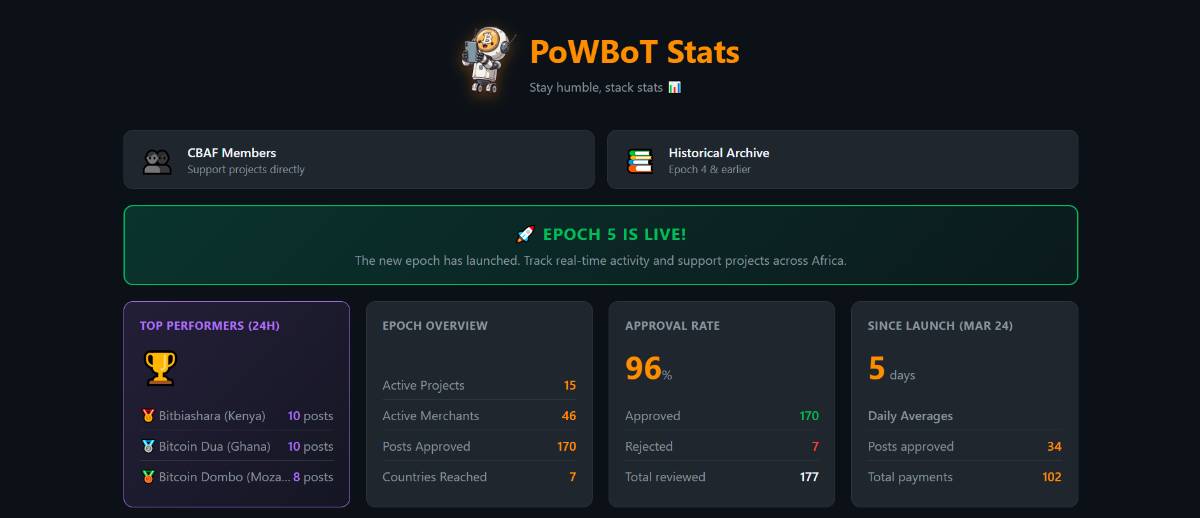
As of Epoch 5, launched March 24, 2026, PoWBoT is tracking:
- 15 active projects across 7 countries
- 46 active merchants
- 170 posts approved with a 96% approval rate
- 102 total Lightning payments sent. In its first five days, the dashboard was averaging 34 approved posts per day.
Top performing projects in the current epoch include Bitbiashara in Kenya, Bitcoin Dua in Ghana, Bitcoin Dombo in Mozambique, Bitcoin Ekasi in South Africa, and Bitcoin Ikorodu in Nigeria.
You can follow it all live at powbot.africa, and browse the full historical record going back to Epoch 4 and earlier in the archive.
What This Proves
The point of PoWBoT is not just the bot itself. It is what the bot represents.
A community educator in a small South African town, with no programming background, used freely available AI tools to build working software that now automates accountability and reward for real Bitcoin adoption across an entire continent. It took a few weeks and a lot of persistence.
The infrastructure it runs on is entirely open:
- Blink API for Lightning payments
- BTCMap for merchant data
- Nostr for public signal amplification
- GitHub Pages for the dashboard
Every tool in the stack is Bitcoin‑native and open source.
This is what building in public looks like. And in Africa, it is already paying merchants.