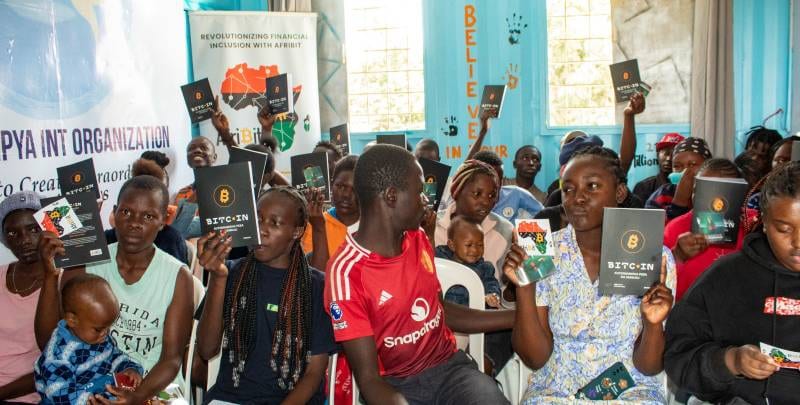
Kibera, one of Africa's largest informal settlements, is not where you'd expect to find a functioning Bitcoin circular economy. Yet Afribit Kibera — built over years of patient community work by founder Ronnie Mdawida — has onboarded roughly 50 merchants and drawn in between 400 and 600 active Bitcoin users, with over 3,000 transactions processed to date.
I did a deep‑dive interview with Ronnie, published on the Blink blog, revealing four unique principles that set Afribit Kibera apart from the many circular economy projects that launch with excitement and then quietly fade.
Principle 01
Trust came first. Bitcoin came second.
Ronnie has been running community initiatives in Kibera since 2010. By the time Bitcoin entered the picture, he already had a decade of earned relationships with waste collectors, youth groups, and local merchants. Afribit Kibera didn't import Bitcoin into a vacuum — it introduced it to people who already trusted the messenger.
"Successful Bitcoin circular economies are almost always built on foundations that existed long before Bitcoin was introduced."
— Hermann, Africa Bitcoin Conference 2025
This is a lesson many projects skip. Ronnie's advice is direct: don't go into a community ranting about Bitcoin with no purpose. Find a need where you already have trust, and let Bitcoin be the tool — not the pitch.
Principle 02
Solve the chicken‑and‑egg problem by creating earners first.
Every circular economy faces the same dead end: merchants won't accept Bitcoin if nobody spends it, and nobody spends it if merchants won't accept it. Afribit Kibera broke this loop by creating earning opportunities first.
The waste management group collects refuse every weekend and gets paid in satoshis. The team then follows those earners to find out where they want to spend (washrooms, sports houses, bike riders) and approaches those specific merchants directly.
It's a bottom‑up demand signal. Merchants aren't being sold an abstract idea; they're being told that paying customers already exist and are ready to spend. That changes the conversation entirely.
Principle 03
Volatility protection is not a compromise, it's a necessity.
For households living close to the economic margin, Bitcoin's price swings are a real barrier. Afribit Kibera has leaned on Blink Wallet's StableSats feature to give community members a way to hold dollar‑pegged value while remaining inside the Bitcoin ecosystem.
This isn't a concession to Bitcoin skeptics, it's a practical bridge that keeps people in the system long enough to build conviction and habits.
Bitcoin has also proven cheaper than M‑Pesa for everyday transactions, and families abroad are using it to send remittances home without the predatory fees of traditional corridors. The technology is solving real, felt problems... not theoretical ones.
Principle 04
Start with financial literacy, not Bitcoin.
Perhaps the most counterintuitive advice from a Bitcoin circular economy founder: don't open with Bitcoin. Ronnie's recommendation is to begin with financial literacy classes (savings, value, money) and only then introduce Bitcoin as the tool that enhances what people already understand.
"You are not trying to prove anything to anyone. You are trying to elevate a community. If your heart is in the right place, everything else falls into place."
— Ronnie Mdawida, founder, Afribit Kibera
The approach has produced something rare: community members buying satoshis voluntarily, saving in Bitcoin, and teaching each other peer‑to‑peer. Cultural markers (profile pictures changed to Bitcoin symbols, businesses branded with Bitcoin iconography) signal a shift that no top‑down campaign could manufacture.
Afribit Kibera is still building. Ronnie doesn't claim success, and he's explicit about the challenges: outdated phones, limited data access, insufficient equipment, and a demand for Bitcoin education that far outpaces the team's capacity to deliver. But the foundation is real, the community is genuine, and the model is replicable — for anyone willing to do the slow work first.
Read the full conversation with Ronnie: Building Bitcoin from the Ground Up: How Afribit Kibera Is Turning a Slum Into a Bitcoin Circular Economy