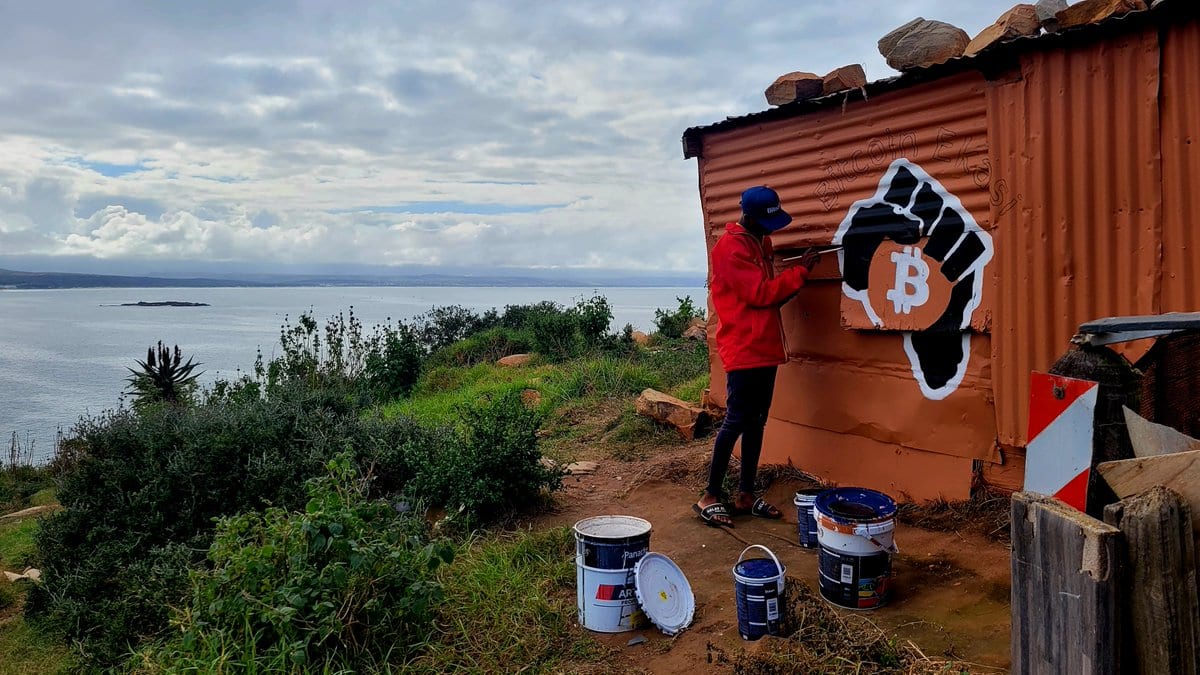
South Africa's Bitcoin season in early 2027 runs across late February and early March: the Adopting Bitcoin Cape Town conference, a Garden Route road trip through six circular economies, and the communities that host them. It leads into the Pan‑African Bitcoin Tour 2027, which flies out of Cape Town into Uganda, Kenya, and Zambia.
What is a Bitcoin circular economy?
A Bitcoin circular economy is a local system where people earn, spend, save, and receive Bitcoin within their own community, so value passes through multiple people and businesses before it's converted back into local currency. A waste collector spends sats at a shop, that shop pays a supplier in sats, the supplier pays staff in sats.
El Salvador's Bitcoin Beach in El Zonte is widely credited as the model. Similar projects now run across Kenya, Uganda, Zambia, and South Africa. See also: Building Sustainable Bitcoin Circular Economies and The African Bitcoin Circular Economy Summit 2026.
Adopting Bitcoin Cape Town 2027
Adopting Bitcoin Cape Town runs 26 to 27 February 2027 at Workshop17 Watershed. It describes itself as the boots‑on‑the‑ground conference for real‑world adoption in Southern Africa. See our recap of the 2026 edition.
The conference is organized by the Adopting Bitcoin team, with Bitcoin Ekasi as its closest community partner. Hermann Vivier, who founded Bitcoin Ekasi, is also part of organizing the conference. Tickets are sold in Rand through Pretix.
What is Bitcoin Ekasi?
Bitcoin Ekasi is a circular economy in Mossel Bay, South Africa, modeled on Bitcoin Beach and built as an extension of The Surfer Kids, a youth non‑profit founded in 2010. See our piece on how Bitcoin Beach inspired Bitcoin Ekasi. Staff salaries are paid in Bitcoin, and local shops are onboarded to accept it, so money never has to convert back to Rand to be spent locally. The project has drawn support from Block, the Human Rights Foundation, Bitcoin Beach, Fedi, and Bitrefill.
Bitcoin Ekasi Garden Route road trip
After the conference, Bitcoin Ekasi runs a Garden Route road trip from 28 February to 5 March 2027, visiting six circular economies along South Africa's southern coast. It is priced at 0.02 BTC, capped at 20 people, and departs the V&A Waterfront at 09:00. Bookings go through roadtrip@bitcoinekasi.com.
The six named stops:
- Bitcoin Ubuntu — A volunteer‑run project in Swellendam, founded in early 2023 by Glen Jooste, offering free Bitcoin onboarding and education to the local township, with a focus on education and sport.
- Bitcoin Ekasi — Based in a Mossel Bay township and founded in August 2021 as an extension of The Surfer Kids non‑profit. It pays staff salaries entirely in Bitcoin, has onboarded around 30 shops, and runs a walk‑in support center.
- Bitcoin Plett — A volunteer community in Plettenberg Bay that onboards local businesses and runs weekly meetups, with a focus on self‑custody. It is one of the Garden Route's fastest‑growing Bitcoin economies and a Bitcoin Beach grant recipient.
- Bitcoin Sedgefield — A smaller, quieter circular economy in Sedgefield. It has fewer independent Bitcoin‑accepting merchants than Witsand or Plett, though national retailer Pick n Pay lets visitors pay for essentials in Bitcoin.
- Bitcoin Karoo — A circular economy community in South Africa's inland Karoo region.
- Bitcoin Witsand — A community‑driven circular economy in the coastal town of Witsand, championed by Edwin Jones. With more than 45 businesses accepting Bitcoin in a town of a few hundred people, it is often cited as having one of the highest rates of Bitcoin business adoption per capita in the world.
Book the Garden Route road trip
Six circular economies, one week, paid in Bitcoin. The road trip runs 28 February to 5 March 2027 at 0.02 BTC per person and is capped at 20 seats, so it fills fast. To claim a spot, email roadtrip@bitcoinekasi.com before the seats are gone.
If you are heading on to East Africa afterward, the trip connects into the Pan‑African Bitcoin Tour 2027, which flies out of Cape Town into Uganda, Kenya, and Zambia.