Introduction
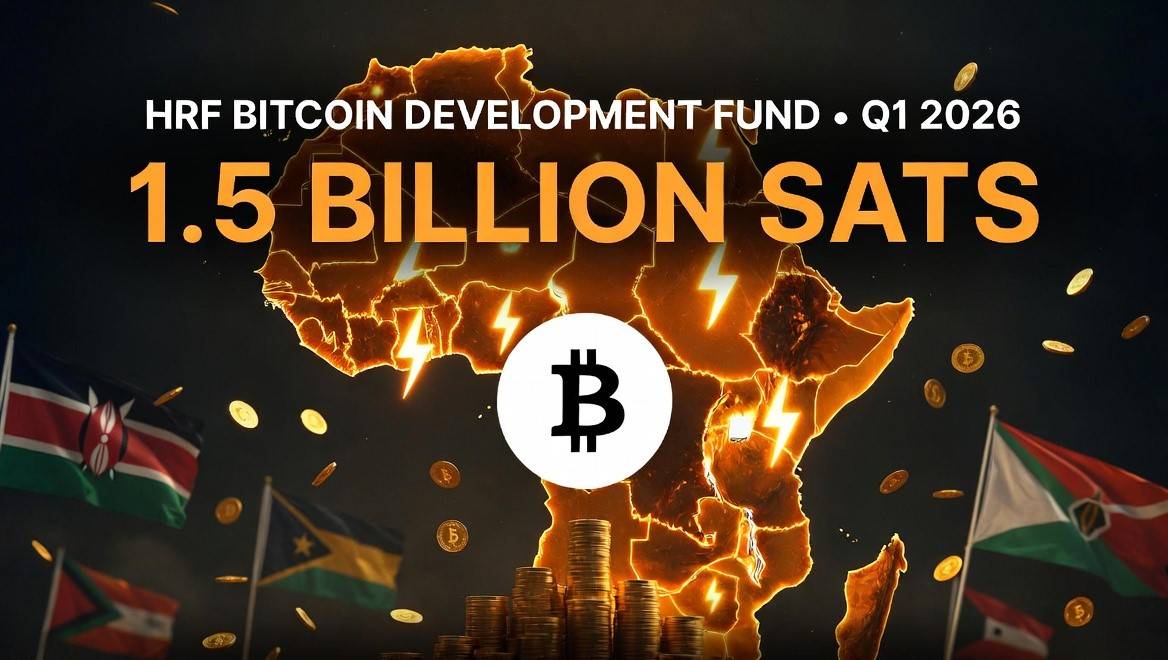
On April 1, 2026, the Human Rights Foundation (HRF) announced the latest round of its Bitcoin Development Fund (BDF): 1.5 billion satoshis distributed across 26 projects operating in Africa, Asia, Latin America, and the Caribbean. The funding targets open‑source software development, Bitcoin research, grassroots education, and financial privacy tools, with a particular focus on the 6.2 billion people living under authoritarian regimes worldwide.
Africa features prominently in this round. Across seven countries (Senegal, Tanzania, Kenya, Benin, Burundi, Nigeria, and Egypt). HRF‑backed projects are building the infrastructure, education networks, and payment rails that turn Bitcoin from an investment concept into a practical financial tool for ordinary people.
This article examines each African grantee, the problem they are solving for Bitcoin adoption on the continent.
Why the HRF Bitcoin Development Fund Matters for Africa
The World Bank's Remittance Prices Worldwide database consistently shows Sub‑Saharan Africa as the most expensive remittance corridor in the world, with average fees exceeding 8% per transaction, more than double the UN Sustainable Development Goal target of 3%.
HRF's Bitcoin Development Fund addresses this problem directly. Rather than funding theoretical research, the BDF invests in functional tools; applications that reduce remittance costs, enable merchant payments, provide self‑custody education, and build local developer talent.
In environments where governments can and do pressure centralized financial institutions, Bitcoin's censorship‑resistant properties are not abstract: they represent a meaningful layer of protection for activists, journalists, and everyday citizens.
The full Q1 2026 announcement is available on HRF's official website and covered in detail by Bitcoin Magazine.
African Projects Funded in Q1 2026
Banxaas: Senegal and the West African CFA Zone
Banxaas is a platform developed by Bitcoin builder Nourou that enables instant exchanges between the CFA franc and Bitcoin without requiring users to create accounts or submit to the KYC processes typical of centralized exchanges. This is particularly significant in the CFA franc zone, where monetary policy is set externally and economic sovereignty is structurally limited for 14 West African countries.
HRF's grant will support the completion of Banxaas's mobile application and the integration of additional mobile money providers, expanding Bitcoin access across West Africa without routing users through institutions that governments can pressure or surveil.
ChapSmart: Tanzania
ChapSmart, developed by software engineer Brian Mosha, bridges the Lightning Network directly to M‑Pesa, Tanzania's dominant mobile money platform. The application allows users to send remittances, pay bills, and transact in Bitcoin at a fraction of the cost charged by traditional corridors, all without leaving the mobile money infrastructure that Tanzanians already use daily.
Tanzania consistently ranks among the countries with the highest remittance fees globally. HRF's grant will support ChapSmart's continued development, user outreach, and education programming to drive adoption.
Tando: Kenya
Tando solves a fundamental adoption challenge: merchants are reluctant to accept Bitcoin because they need local currency to pay suppliers, rent, and staff. Tando resolves this by allowing customers to pay in Bitcoin via the Lightning Network while merchants receive Kenyan shillings instantly through M‑Pesa. The merchant never holds Bitcoin; the customer never needs a bank account.
This model has been described by Bitcoin educators as the practical implementation layer that African retail Bitcoin adoption has been missing. HRF's funding supports Tando's expansion beyond Kenya into neighboring markets.
Tapnob: Pan‑African
Tapnob provides straightforward Bitcoin on- and off‑ramps via local bank transfers, enabling users to buy Bitcoin and convert back to local currency as needed, while keeping the remainder in self‑custody.
HRF supports Tapnob's operational expansion and the deepening of its educational resources across multiple African markets.
Bitcoin Benin: Benin
Bitcoin Benin is a collective of educators and developers building a physical Bitcoin Knowledge Hub in Benin, a permanent learning center and co‑working space where community members can learn to use and build Bitcoin tools.
HRF's grant supports the hub's physical infrastructure and the 2026 Bitcoin Mastermind conference, with workshops and training programs expected to reach more than 1,000 participants.
BTC Shule: Burundi
BTC Shule runs an eight‑month Bitcoin developer accelerator program in Burundi, combining structured technical training, hackathons, stipends, and mentorship to produce developers capable of contributing to open‑source Bitcoin projects. The program is specifically designed for participants operating under authoritarian conditions, equipping them with skills to build censorship‑resistant financial tools.
HRF's funding supports program delivery and participant stipends, ensuring that financial constraints do not prevent talented developers from completing the full curriculum.
Daniel Batten: Research Covering Nigeria, Ethiopia, and Egypt
Researcher and analyst Daniel Batten is conducting in‑depth analysis of Bitcoin regulation risks in Nigeria, Ethiopia, and Egypt, three of Africa's largest economies and three of its most complex regulatory environments.
The research equips activists, civil society organizations, and policymakers with data‑driven arguments against restrictive Bitcoin legislation.
HRF's grant supports the research program and associated outreach efforts, ensuring findings reach the communities and advocates who can act on them.
The Broader Round: Global Context
While the African grantees are the focus of this article, the Q1 2026 round also includes significant investments in Bitcoin Core privacy enhancements, self‑custody hardware tools such as Krux and SeedSigner, multilingual education initiatives including DIYbitcoin's hardware wallet workshops across Africa, Latin America, and Asia, and developer support programs including Summer of Bitcoin.
A full list of all 26 grantees is available in the official HRF announcement and Bitcoin Kenya's coverage.
The Significance of This Funding Round for African Bitcoin Adoption
Taken together, the African grantees in this round address the full adoption stack: the infrastructure layer (Lightning Network bridges via ChapSmart and Tando), the access layer (Banxaas and Tapnob's on‑ramps), the education layer (Bitcoin Benin's Knowledge Hub and BTC Shule's developer accelerator), and the policy layer (Batten's regulatory research). No single component is sufficient on its own; HRF's portfolio approach funds all of them simultaneously.
This is consistent with how the HRF frames its Bitcoin Development Fund's mission, not to fund speculation or price‑driven interest, but to build the conditions under which Bitcoin can function as a practical financial tool for people who need it most.
Conclusion
The Human Rights Foundation's Q1 2026 Bitcoin Development Fund round is one of the most consequential grant cycles for African Bitcoin development to date. The seven African projects receiving funding represent a coordinated, multi‑layer investment in the infrastructure, education, and policy environment that Bitcoin adoption in the region requires.
The work being done by builders in Dakar, Dar es Salaam, Nairobi, Cotonou, and Bujumbura does not make international headlines. HRF's funding (and the attention it draws) helps ensure that it should.
For the complete list of all 26 global grantees, visit the official HRF announcement.
Developers and organizations interested in applying to future HRF Bitcoin Development Fund rounds can find application details at hrf.org/program/financial‑freedom/bitcoin‑development‑fund.