Machankura, which lets people send bitcoin from basic phones over USSD, announced Bennu on October 25. It is an experimental Bitcoin wallet whose main screen is an end‑to‑end encrypted group chat. Members make a shared key in pieces on their own phones, and a set number of them must agree before any coin moves.
Bennu's site describes it as "the arrangement a family or a savings club already has, written down in script instead of trust."
Here's how the group wallet works, how groups nest inside each other, what the Lightning side adds and how to try it.
How Bennu's Group Wallet Works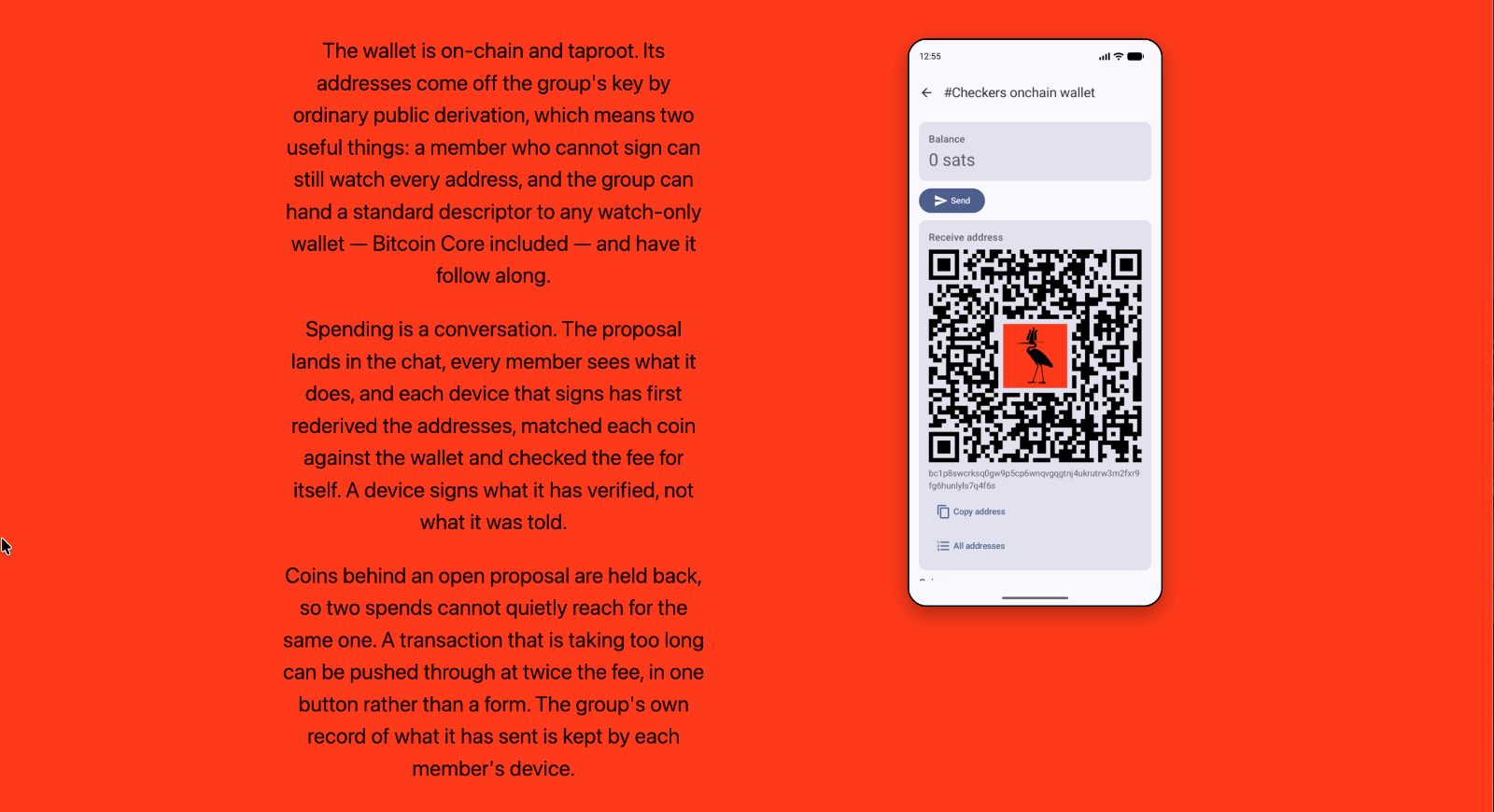
Each member starts with a profile made from 12 words that never leave their device. The group then runs a key ceremony inside its own encrypted chat. Every member's device adds secret material, and the result is a t‑of‑n key: it takes t of the n members to sign, and fewer than t can do nothing.
The key uses FROST, a method that lets several people produce one ordinary Bitcoin signature together, Machankura said. The site says the key is never put back together anywhere, so no server, group founder or single phone holds it.
Spending works as a conversation. A member posts a proposal in the chat naming the address, the amount and the fee. Each device that signs first rederives the addresses, matches the coins and checks the fee for itself. Coins behind an open proposal are held back, so two spends can't reach for the same one.
The wallet is on‑chain and uses Taproot. Members who can't sign can still watch every address, and the group can export a standard descriptor so a watch‑only wallet such as Bitcoin Core can follow along.
Clans Within Clans: Bennu's Subgroups and Guardians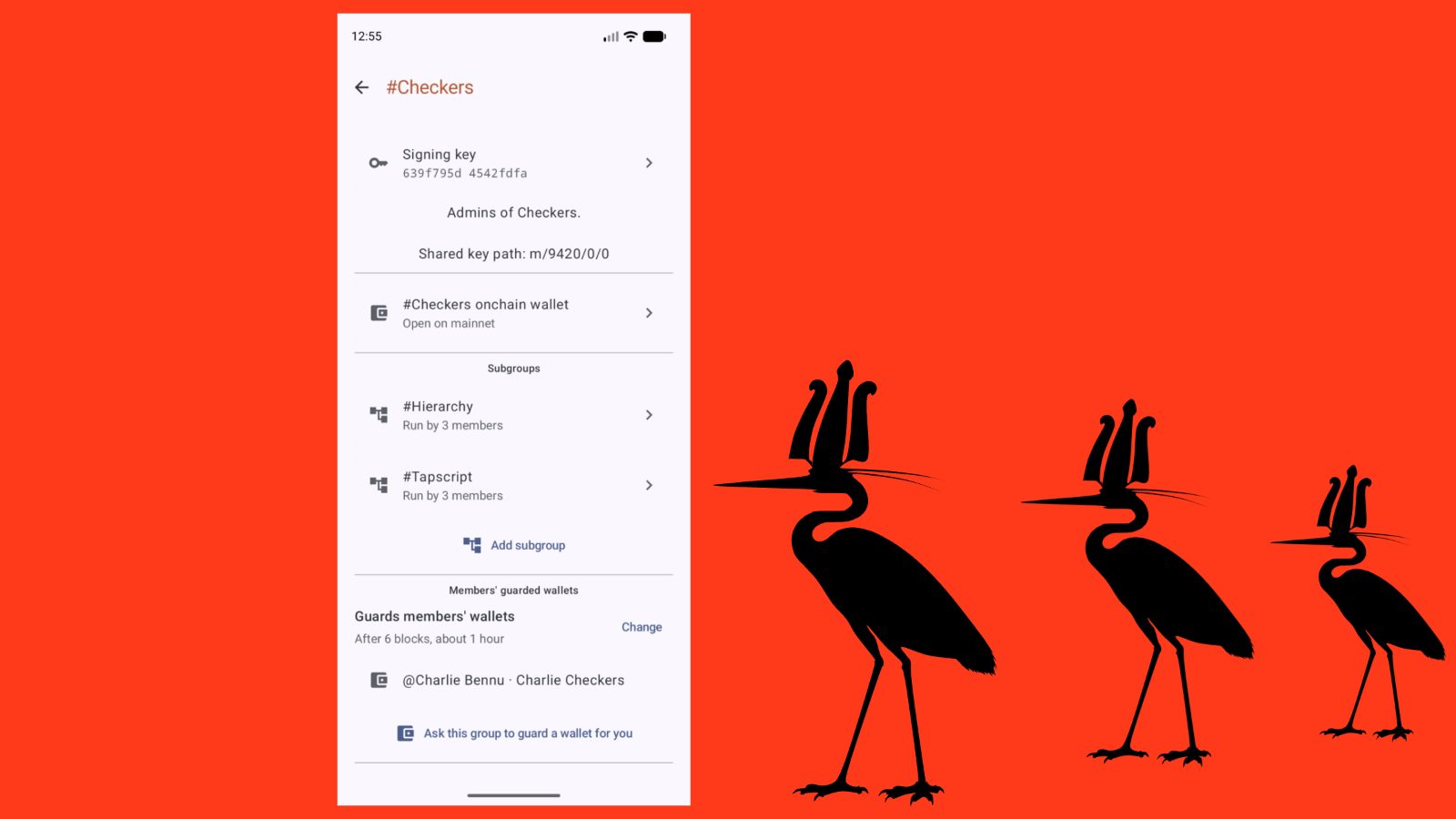
A Bennu group can create a child group with its own chat, its own ceremony and its own key. The child's key is fresh, not derived from the parent's, so losing it never puts the parent at risk. A "birth certificate" signed by the parent's quorum ties the two together, and anyone can check it.
When a group creates a child, it decides whether to guard the child's wallet. Every group above a guarded group becomes a guardian with a backup way to spend, but only after a coin has sat for the delay that guardian chose. The delay can run from 6 to 65,535 blocks, with 12 blocks, about two hours, as the usual setting. The site says these backups are for the day a child's members are gone, a device is lost or a quorum can no longer be reached.
The same setup works for one person. A member's own guarded wallet spends with a single signature and no one's approval. The group can step in only after the delay, and only if the owner hasn't moved the coin first. The site also has a tool to visualize an org chart as Bennu groups and the spending rules each one carries.
Bennu's Lightning Wallet and the 1 Million Sat Cap
Bennu groups can also open Lightning channels. The key that funds them is held the same way as the on‑chain key, and a channel that closes pays back to the group's on‑chain wallet, so a group needs that wallet first.
One member at a time runs the Lightning node on their own device. Every commitment the node needs signed goes to the other members' devices, which rebuild it and refuse anything that doesn't match, so the operator can't move the group's money alone. Payments, channel closes and force closes each need a group authorization with a budget on it.
The site calls this "the newest part of Bennu and the least proven." The threshold scheme behind the funding key hasn't been reviewed outside the project, so each channel is capped at 1 million sats, and the node runs only while the operator has the app open.
Machankura said on October 27 that Bennu's channel signing uses ICEBERG, a scheme from a 2026 paper by Paul Gerhart, Nadav Kohen, Jesse Posner and Matias Furszyfer, which Kohen also explains on his blog. It lets one side of a Lightning channel act as a signing group while the other side sees an ordinary participant.
Kgothatso Ngako, Machankura's founder, said he decided to try threshold signatures in a mobile Lightning wallet after reading the paper and seeing a proof of concept built on eclair, ACINQ's Lightning node software. He named the wallet Bennu as a nod to Phoenix, ACINQ's Lightning wallet. In Egyptian myth, the Bennu is a bird often linked to the phoenix.
Who Built Bennu and How to Try It
Kg wrote nearly all of Bennu's code, its GitHub history shows. The project's notes say the app grew out of a fork of Phoenix. Its commit history shows it went by Mantra, Curated and Curare before it was renamed Bennu on October 20.
Machankura's USSD wallet holds bitcoin for its users. Bennu holds neither coins nor keys. "There is no Bennu account, no balance on our side, and nothing for us to freeze or lose," the site says. Messages travel over Nostr relays and the chain is read through Electrum servers, and users can change both.
An Android build is available to try ahead of any app store release, and the code is open on GitHub. The site says plainly that Bennu is experimental: "keep to amounts you would not mind losing."
Sources
- Bennu announcement (Machankura on X, October 25, 2026)
- Bennu's Lightning channels use ICEBERG (Machankura on X, October 27, 2026)
- Why Kgothatso Ngako built a threshold Lightning wallet (Kgothatso Ngako on X, October 27, 2026)
- Bennu (Bennu website)
- bennu‑kmp (Machankura on GitHub)
- Enabling Threshold Custody for the Lightning Network with Nested Threshold Multi‑Signatures (IACR ePrint, 2026)
- Iceberg: Nested Threshold Signatures for Lightning (Nadav Kohen, August 28, 2026)
- Machankura: Send Bitcoin on a Basic Phone With No Internet (Bitcoin Africa Story, September 15, 2026)
- Kgothatso Ngako (Bitcoin Africa Story directory)